Moza MRP Rudder Pedals Review

Steve | G-LOC MEDIA
Flight simulation enthusiast and YouTuber
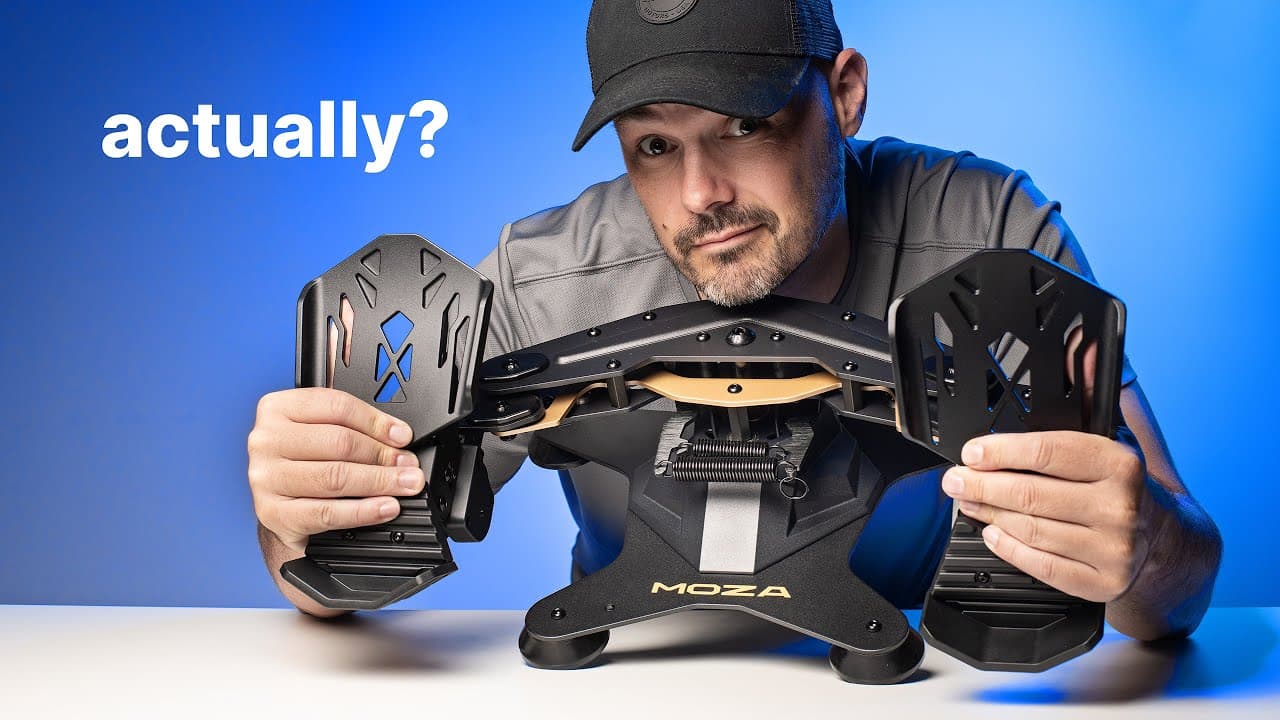
The MOZA MRP rudder pedals come in at $349 and honestly feel like they should cost more. Full aluminium construction, ultra-smooth yaw movement, and a center detent that's genuinely one of the best I've felt at this price point. The optional damper adds a nice touch but brings some minor stickiness with it, and on the softest setting it still won't let the pedals fully return to center, so it's not a must-buy for everyone. Strip the damper out of the equation and these are arguably my favourite feeling rudder pedals tested so far.
Pros
- Fair price, not too expensive, also not cheap
- Heavy and well built, reconfirms what you’re paying
- Super smooth and accurate yaw axis
- Good floor grip, can be butted up against a wall (without damper)
- Removable heel rests for different flying styles
- Great adjustability, especially the footplate angles
Cons
- Spacey, futuristic look
- A little too wide at 54cm
- Damper is a smidgen too strong even on softest settings
MOZA MRP Rudder Pedals Price and Market Position
The flight sim community has been asking for an affordable Do we really need another set of flight sim rudders? That’s the question I set out to answer when MOZA released their new MRP rudder pedals and the optional adjustable damper.
Right off the bat, I think the first question people will have is: “Do I really have to buy the damper?” The answer is a bit elusive. In some senses yes, but in others, you don’t. I’ll cover the reasons why you might or might not want it later in this review.
Price-wise, I would call these a mid-range set of rudder pedals. Based on pricing alone, the MOZA MRP sits in that lower to mid-range bracket. But here’s the thing, that’s not where I found these set in terms of value. For what you get, the way they’re built, the features, and the finish, all of that suggests something different.
MOZA MRP Features and Design
Full Aluminium Construction
You’re looking at a full aluminium frame and internals. It has a sandblasted metal feel to most of the components, with the exception being the toe and heel rests. Those are made from a tough matte finish plastic with honeycomb webbing underneath.Removable Heel Rests
When I first saw the heel rest design, I was a bit disappointed. But then I discovered something clever, you can unscrew the lower plate from the bottom to release the actual heel plate.This allows you to push the rudder like you would in a smaller GA-style aircraft, essentially having your heels slide along the floor while using your toes on the bottom portion of the pedals. The fact that we can have this heel rest on or off is great for different flying styles.
Adjustable Pedal Angles
The pedals themselves can have the angle adjusted to quite a steep incline. The pedal angle adjustability really comes into its own, as I can get these pedal faces really quite vertical if I wanted to.Swing Arm Design with 15cm Travel
The actual rudder design is a swing arm design with up to 15 centimetres of travel. The “up to” refers to the adjustable stopper that can be screwed in to limit the range.The only thing about this type of swing arm design is that it’s not linear in the way a real rudder pedal works. You’re rotating around an arc and you can feel it, it’s just inherent with this type of design.
Adjustable Spring Tension
The centering force can be adjusted by changing or pulling off some of the springs. It’s a very basic adjustment, but it works quite well.Floor Grip and Placement
These are fairly large rudder pedals, and in my testing, they performed well:- On carpet: Good grip, though they will move slightly over time
- On laminate flooring: Good performance (minimal movement)
- On tiles: Extremely good grip (Best of all but still slips under excessive load)
They’ll move more if you’re using your toes to push the bottom portion of the pedals. You’ll always get a better experience if you can hard mount them to a cockpit.
Wall Placement Note
Another neat feature, you can have these butted up against a wall without any trouble. At full extension against a wall, you’ve still got about an inch gap before the back end of the pedals will actually touch the wall.However, super important to know: if you have the damper installed, you cannot do that. It just slightly scuffs the wall. Definitely keep that in mind if you plan to buy the rudders with the damper.
MOZA MRP Dimensions Compared
The MOZA MRP pedals are quite wide at 54cm outside to outside point of the pedals. Here’s how they compare:- Thrustmaster TPR 51.5cm
- WinWing Orions 53cm
- VIRPIL 53cm
- MOZA MRP 54cm
A width adjustment would have been nice, but these are still a very adjustable set of rudder pedals overall. More or less, every adjustment you would need is covered.
Build Quality Assessment
I don’t think it matters how cheap or expensive gear of this sort is, everyone wants to feel something substantial in their hands, or their feet for that matter. The MRP pedals are exactly that.The metal has a strong, nicely finished matte look. The construction feels heavy and solid. Build quality wise, I’d say they mildly exceed that of the VIRPIL Ace pedals, which are very good and around the same price point.
Anyone that spends $350 USD on these will be happy when they pull them out of the box.
How Do the MOZA MRP Rudders Feel?
This is where things surprised me. Everything I’ve spoken about so far is not including the damper upgrade, and yet these do feel a little bit dampened out of the box, especially through that center detent.Ultra-Smooth Center Detent
The detent is just ultra smooth — if you can even call it a detent because it’s barely there. It’s a very silky transition all the way through. The travel through the center detent is dull and smooth, just enough to let you know you’re crossing the center, but at the same time very easy to have fine inputs and hold position.The unit is as smooth and as precise as it gets, equalling that of the VIRPIL Ace rudders and the TPRs, which in terms of precision and smoothness are some of the best you can buy at this mid-range price point.
Where MOZA Pulls Ahead
Where MOZA pulls ahead is that dampened feel through the middle — and remember, that’s without the damper add-on. This is one of what I would say is the MOZA MRP’s strongest points.As much as I don’t like the way these rudders look, I just love the way they feel.
Toe Brakes
As far as the feel of the toe brakes go, they are nothing special. They’re smooth, but maybe lack the feel of what you might get on the WinWing Orions. They have a very similar feel to the VIRPIL Ace though. So for toe brakes, pretty much just what you would expect.MOZA MRP Adjustable Damper Review
This is where things get a little bit complicated.Should You Buy the Damper?
The feel of the rudders without the damper is excellent across the board. In fact, the more I was using them, the more I felt these could be the smoothest, best-feeling rudders I’ve ever tested.But when I added the damper, yes, it did improve the way they felt for me, but there was an ever-so-slightly sticky element to them on really minor movements. It’s harder to feel through the feet, but it’s there, much easier to feel through your hands.
Let me reiterate: it is very minor, but it’s there. Rudder setups like this are prone to that, so it’s nothing really that new. The VIRPILs suffer from it (maybe a little bit less), and the Orions have it a little bit as well.
Damper Strength Issues
On top of that slight stickiness, I felt I couldn’t get the damper to be soft enough. Even on the softest settings, the rudders just won’t return to full center. That’s not an issue I’ve had with other damper-modded rudders I’ve tested.The Verdict on the Damper
I do like the feel of the damper add-on, but it does pull the MOZA MRPs very much back in line with other great examples like VIRPIL and WinWing. Take the damper out of all of them though, and the MOZA MRPs shine just a little bit brighter in terms of smoothness and the way that center detent feels.My recommendation:
For helicopter pilots: The damper is a no-brainer as you can remove the spring return. For fixed-wing pilots: It might be best to leave the damper out first. See what you think of the feel before splashing out another $70.
Software Setup
Software-wise, there’s not much to cover. For this product, the MOZA Cockpit software is pretty basic, just calibrate and you’re done. The only thing left to do is assign the Y-axes. Everything just worked, up and running in two minutes.Final Verdict: Is There Value for Money?
I’d say there is. I do think they’ve hit a keen price point. For what you’re paying, it’s a good product. The main things are all there, a smooth and precise yaw with a nice minimal center detent that’s easy to control through that middle portion.Does it leap and bounds ahead of the competition? No. If dampers were removed from the scenario completely, it’s my favourite rudder pedal in terms of feel. With the damper and comparing it to the damper of all the others, it’s kind of swimming in a sea of sameness.
For anyone pulling the trigger, I don’t see how you could be disappointed. Just know there are other similar options with similar performance, namely the WinWing and VIRPIL products, which are also semi-comparable in price.
The bottom line: The MOZA MRPs offer a great price, a great feel, and are well built. Not head and shoulders above the rest, but definitely holding their own.
Frequently Asked Questions
Affiliate Disclosure: Some links on this page are affiliate links. If you click and make a purchase, I may earn a small commission at no extra cost to you. I only recommend products I personally believe in.